In fields like industrial automation and smart device communications, connecting serial devices to Ethernet is crucial for efficient data transmission and remote management. Serial device servers are the core devices that bridge the gap. This article will delve into the definition, purpose, operating principles, and configuration of serial device servers, as well as answer related frequently asked questions, to help readers gain a comprehensive understanding of this important communication conversion device.
What is a Serial to Ethernet Converter?
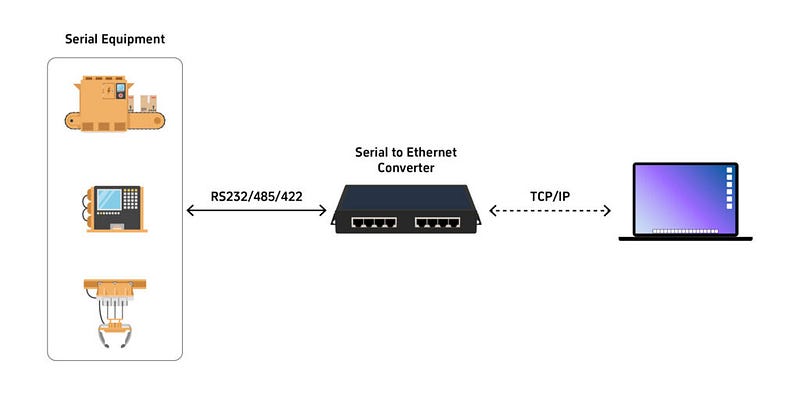
A Serial to Ethernet Converter, as the name suggests, is a device that converts serial communication interfaces (such as RS232, RS485, or RS422) into Ethernet interfaces (such as RJ45, SFP). It allows traditional serial devices to connect to modern networks and exchange data using the TCP/IP protocol.
This is especially useful for devices that cannot directly connect to the network — such as printers, barcode scanners, PLCs, sensors. By using a converter, you can achieve remote data acquisition, monitoring, and control, greatly improving efficiency and flexibility.
Types of Serial Device Servers
Depending on the number of ports, network connectivity, and application scenarios, serial servers are commonly divided into three categories:
Single-Port Serial Server
- Compact, simple to configure, ideal for single device networking.
- Commonly used with POS machines, time attendance devices, or a single PLC/sensor.
Multi-Port Serial Server
- Provides 2, 4, 8, 16, 32 or more serial ports for multiple device connections.
- Suitable for industrial sites with many devices, such as factory automation, monitoring systems, and data acquisition centers.
- Enables centralized management, reducing wiring costs.
Wireless Serial Server (WiFi Serial Server)
- WiFi serial server equipped with a built-in WiFi module for wireless transmission of serial data.
- Useful in environments where wiring is difficult (warehouses, mobile devices, temporary test sites).
- Flexible installation without dependency on wired Ethernet.
How Does a Serial to Ethernet Converter Work?
The working principle of a serial device server (serial to Ethernet) is to package serial port data into TCP/IP data for transmission on the network, and then depacketize and restore it to serial port data, thus achieving seamless connection between traditional serial port devices and modern networks.
Serial Signal Reception
- The converter receives serial signals from devices (RS232, RS485, or RS422).
Data Encapsulation and Conversion
- The serial data is processed and encapsulated into TCP/IP packets.
- Essentially, it translates serial communication protocols into network protocols.
Network Transmission
- The converted data is transmitted over Ethernet to remote systems.
Decapsulation and Output
- The receiving converter unpacks the TCP/IP data and restores it into serial data for the target device.
Two-Way Communication
- Many converters support bidirectional communication: data can flow from serial to Ethernet and from Ethernet back to serial.
- This is why it’s possible to do Ethernet to serial then back to Ethernet.
Advantages of Serial to Ethernet Converters
Extended Communication Distance:
Traditional serial port transmission distances are limited. For example, RS-232 typically has a range of around 15 meters. Ethernet allows data to be transmitted over much greater distances, theoretically up to 100 meters or even longer.
Networked Management:
Serial devices are no longer limited to local connections. Ethernet can be integrated into existing networks for centralized management, remote monitoring, and configuration.
Strong Compatibility:
Supports multiple serial port standards (RS-232/485/422), making them compatible with various industrial control, POS, sensors, PLCs, and other devices.
Transparent Transmission: Serial-to-Ethernet converters typically support “transparent mode,” which does not modify data content, ensuring that existing application protocols can be transmitted over the network without modification.
Multiple Operating Modes:
Common modes include TCP Server, TCP Client, UDP, and virtual serial port drivers, facilitating integration into diverse application scenarios. Reduced cabling costs: Devices can be connected using existing Ethernet cabling, eliminating the need to install and maintain dedicated serial cables.
Improved Transmission Rate:
Ethernet technology offers transmission rates far higher than traditional serial communications, reaching 10Mbps, 100Mbps, and even 1Gbps, significantly improving data transmission efficiency.
Applications
Retail and Commerce
In retail and commercial settings, point-of-sale systems and warehouse barcode scanners connect to backend systems or cloud platforms via serial servers. This enables rapid transmission of transaction data and scanned information, facilitating real-time sales tracking, inventory synchronization, and equipment monitoring. It minimizes downtime losses and enhances operational efficiency.
Smart Factory Energy Management
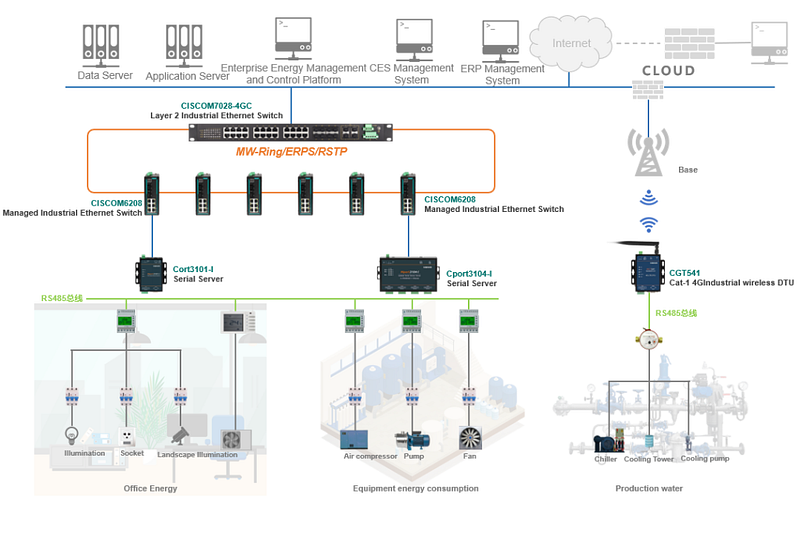
In smart factory energy management scenarios, serial servers serve as the core data hub. Connecting serial devices such as Illumination and socket equipment in office areas, as well as air compressors, pumps, and fans in production zones via RS232/RS485 interfaces, it overcomes interface and transmission limitations through serial-to-Ethernet conversion. This transforms dispersed energy consumption data into Ethernet signals, which are then transmitted in real-time over the network to the central energy management platform. This provides foundational data support for remote energy monitoring, precise analysis, and cost control.
Urban Utility Tunnel Communication Monitoring
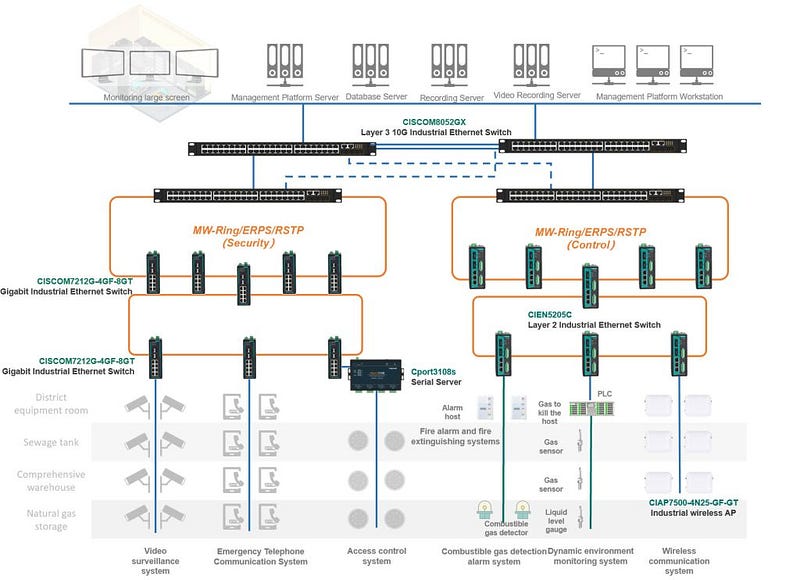
In the urban integrated pipeline corridor monitoring system, the serial port server is a key node connecting the lower-level equipment and the upper-level management platform. It interacts with the access control system equipment through the serial port, converts the serial port data output by the equipment into Ethernet data, and reliably transmits it to the management platform server, database server and other components through the communication network, enabling the management platform to obtain access control status, alarm information and other data in real time, providing important data support for real-time monitoring, abnormal alarm and remote management of the tunnel, and ensuring the safe and efficient operation of the tunnel.
F
Conclusion
Simply put, a serial-to-Ethernet converter acts as a “translator” between traditional serial communications and modern network communications. It expands the capabilities of traditional serial devices, supports remote monitoring, and simplifies management. As the Internet of Things and industrial networks grow, serial-to-Ethernet converters will continue to play a vital role in modern automation and connectivity.

請先 登入 以發表留言。