- Dec 05 Fri 2025 14:59
-
Do Access Points Have Ethernet Ports?
- Nov 14 Fri 2025 14:36
-
Understanding the Need for QoS in Network Traffic Management
In today’s hyper-connected digital world, networks have become the lifeline of business operations and everyday communication. However, with the increasing demand for real-time applications such as video conferencing, VoIP, streaming media, and IoT data flows, the pressure on limited bandwidth resources is higher than ever. As a result, Quality of Service (QoS) has emerged as a crucial solution — it acts like an intelligent traffic management system that identifies and prioritizes critical business traffic in complex network environments, ensuring clear voice calls, smooth video streams, and uninterrupted control signals. Whether in enterprise communication or industrial IoT scenarios, QoS plays an irreplaceable role.
What is QoS?
What is QoS?
- Nov 07 Fri 2025 11:43
-
What is the difference between a LAN port and a PoE port?
In network devices, we often see interface names like LAN Port and PoE Port. For non-professionals, they may look similar, but their functions and purposes are quite different.
This article explains in detail what a LAN port is, what a PoE port is, how they work, their differences, and how to choose the right device.
This article explains in detail what a LAN port is, what a PoE port is, how they work, their differences, and how to choose the right device.
- Oct 31 Fri 2025 17:08
-
What Is MRP on Switch?
- Oct 24 Fri 2025 14:54
-
Ethernet Switch Port Mirroring Explained: Everything You Need to Know
In modern networking, data traffic visualization and controllability are crucial for network operations and security protection. As a common feature of network switches and routers, port mirroring enables administrators to capture and analyze network traffic in real time — without interrupting business operations. Whether for troubleshooting, performance optimization, or compliance and security, port mirroring has become an indispensable function in network management.
- Oct 17 Fri 2025 09:41
-
Industrial Data Acquisition: The Core Engine Driving Smart Manufacturing and Digital Transformation
Driven by the wave of Industry 4.0 and smart manufacturing, data has become the new oil of the modern industrial realm. Industrial Data Acquisition (IDAQ) represents the primary and critical first step in capturing this “new oil.” It forms the cornerstone of the Industrial Internet of Things (IIoT) and the digital factory. By converting analog signals from the physical world into analyzable, actionable digital information, IDAQ unlocks boundless possibilities for optimized decision-making, predictive maintenance, and efficiency gains within enterprises.
What is Industrial Data Acquisition?
Industrial Data Acquisition (IDAQ) refers to the process of collecting, transmitting, and processing physical quantities or operational data distributed across equipment, production lines, and factory segments during industrial production. This is achieved through hardware such as sensors, acquisition modules, and industrial gateways, along with corresponding software systems.
Its role extends beyond mere “data collection.” More importantly, it transforms scattered, isolated raw data into standardized, visualized, and analyzable information, providing the foundation for intelligent decision-making.
Types of Industrial Data Acquisition Methods
Industrial data acquisition can be implemented in various ways, broadly categorized into hardware-based and software-based approaches, each suited to different application scenarios and requirements.
Hardware Data Acquisition
Industrial data acquisition hardware typically includes:
Sensor Acquisition
Devices like temperature sensors, pressure sensors, and flow meters convert physical quantities into electrical signals.
PLC Acquisition
Collects field device data via Programmable Logic Controllers (PLCs), then uploads it to host computers or SCADA systems.
Data Acquisition Cards/Modules (DAQ)
Used to capture analog signals (requiring A/D conversion) and digital signals, typically installed in industrial PCs or control computers.
What is Industrial Data Acquisition?
Industrial Data Acquisition (IDAQ) refers to the process of collecting, transmitting, and processing physical quantities or operational data distributed across equipment, production lines, and factory segments during industrial production. This is achieved through hardware such as sensors, acquisition modules, and industrial gateways, along with corresponding software systems.
Its role extends beyond mere “data collection.” More importantly, it transforms scattered, isolated raw data into standardized, visualized, and analyzable information, providing the foundation for intelligent decision-making.
Types of Industrial Data Acquisition Methods
Industrial data acquisition can be implemented in various ways, broadly categorized into hardware-based and software-based approaches, each suited to different application scenarios and requirements.
Hardware Data Acquisition
Industrial data acquisition hardware typically includes:
Sensor Acquisition
Devices like temperature sensors, pressure sensors, and flow meters convert physical quantities into electrical signals.
PLC Acquisition
Collects field device data via Programmable Logic Controllers (PLCs), then uploads it to host computers or SCADA systems.
Data Acquisition Cards/Modules (DAQ)
Used to capture analog signals (requiring A/D conversion) and digital signals, typically installed in industrial PCs or control computers.
- Sep 28 Sun 2025 17:03
-
How Much Voltage Does a Router Use?
In the daily use and selection of network equipment, router performance and signal coverage often take center stage, yet the critical detail of voltage usage is frequently overlooked. However, voltage serves as the “power source” for stable router operation, directly impacting the device’s ability to function continuously and reliably across diverse environments — even influencing its lifespan. Whether in conventional settings like home living rooms or office spaces, or in specialized environments such as industrial production workshops and remote monitoring stations, routers require significantly different voltage specifications. Whether the voltage parameters match the current power environment is the core prerequisite for determining whether a router can function properly in its intended scenario and avoid failures caused by voltage mismatch (such as frequent disconnections or hardware damage). Its importance is no less than that of performance and signal strength, and it must be a key consideration during both purchase and use.
WiFi Router Voltage and Power Consumption for Home and Commercial Use
WiFi Router Voltage and Power Consumption for Home and Commercial Use
- Sep 12 Fri 2025 16:59
-
How Do Serial to Ethernet Converters Work?
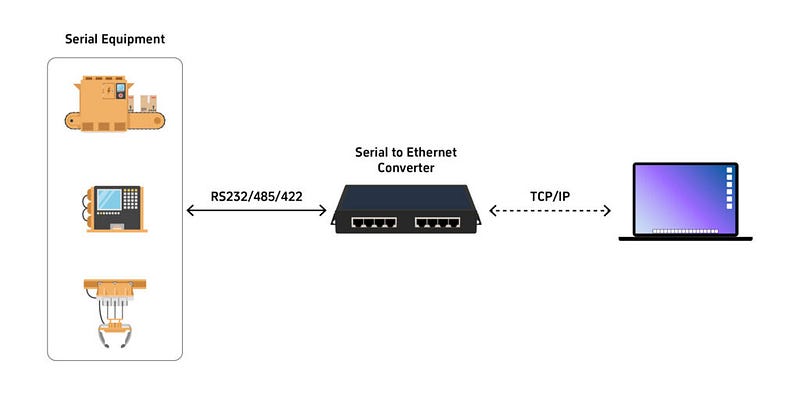
In fields like industrial automation and smart device communications, connecting serial devices to Ethernet is crucial for efficient data transmission and remote management. Serial device servers are the core devices that bridge the gap. This article will delve into the definition, purpose, operating principles, and configuration of serial device servers, as well as answer related frequently asked questions, to help readers gain a comprehensive understanding of this important communication conversion device.
What is a Serial to Ethernet Converter?
- Aug 29 Fri 2025 09:34
-
Ultimate Selection Guide of Industrial Media Converter
As demand for network communication grows in applications such as industrial automation, security surveillance, and smart cities, the limitations of traditional Ethernet in transmission distance, electromagnetic interference, and stability become increasingly apparent. Simultaneously, bus communication protocols like CAN, RS232/RS485 face challenges including short transmission distances and susceptibility to interference. The demand for diverse transmission media is surging, and media converters — critical bridging devices connecting serial ports, Ethernet, and fiber optic networks — are playing an irreplaceable role. They not only overcome Ethernet’s transmission limitations but also address the pain points of bus communication, delivering exceptional versatility through a comprehensive product portfolio.
What is a Media Converter
What is a Media Converter
- Aug 21 Thu 2025 16:58
-
What Is the PoE Switch Distance Limit?
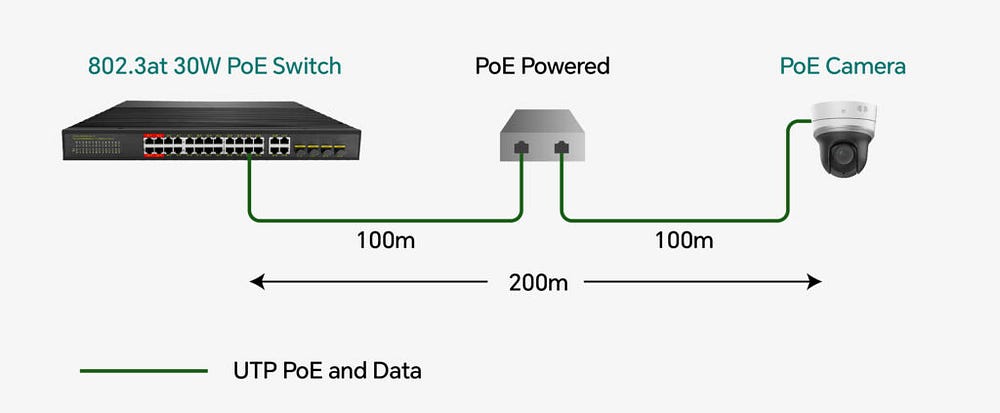
In the field of network cabling and device power supply, Power over Ethernet (PoE) technology has become widely adopted due to its ability to transmit both data and power over a single Ethernet cable. In industrial environments, industrial switches are key network devices that are adapted to harsh conditions. They are often combined with PoE technology to become core components of industrial PoE systems, so understanding the PoE switch distance limit and how to optimize deployments around it is critical. This article explores the Power over Ethernet distance limitations and how to effectively work within or overcome them.
- Aug 19 Tue 2025 17:18
-
Analysis of Core Power Factors of Industrial PoE Switches: From Parameters to Selection
With the continuous development of industrial automation and IoT technologies, industrial PoE switches (Power over Ethernet switches) are playing an increasingly vital role in smart manufacturing, intelligent transportation, security surveillance, power automation, and other scenarios. These switches not only transmit data over Ethernet but also provide power to terminal devices simultaneously, greatly simplifying wiring work and improving system reliability. Power-related performance metrics, such as PoE switch power budget, PoE switch power consumption, PoE switch power supply, and per-port wattage, directly impact the stable operation and scalability of devices in industrial environments. The following is an in-depth analysis of the power performance and key selection points of industrial PoE switches from multiple dimensions.
